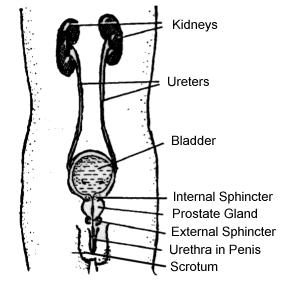
Urinary tract refers to the system that is concerned with formation storage and excretion of urine. It consists of two kidneys that lie at the back of upper part of abdomen, one on each side. Urine formed in the kidneys is drained by two hollow tubular structures, called the ureters into the bladder.
Bladder is a hollow muscular bag that lies in the lower part of abdomen. Bladder serves to hold urine till it is full and then contracts to empty itself through another hollow tube called urethra, to the outside. A muscular valve, called the sphincter, located in the urethra, keeps the urethra closed & opens when a person wishes to pass urine.
Note:
Spinal cord injury at any level almost always effects control over the bladder. This is because the nerves controlling these internal organs are attached to the very base of the spinal cord (levels Sacral two-four). Although one will not have the same control that used to be before injury, but choosing the correct technique from the existing can help to manage one's bladder quite successfully and re- establish control to lead a normal life.
Urine is stored in the bladder. As the bladder becomes full this information is passed via your spinal cord centers to your brain. If you wish to empty your bladder, then the bladder muscle contracts to empty the bladder.
Normally the desire can be modified. One can suppress the desire to pass urine until an appropriate time or place is available. Usually, the bladder empties completely leaving behind insignificant residue. Presence of large volume of urine at the end of voiding happens either because of weak muscles or some obstruction along the outlet.
After a spinal cord injury the nerves are no longer in communication with the brain. The bladder continues to fill, but the spinal injured person no longer is aware of the sensation of a full bladder. He/she no longer has the ability to control the bladder. In the first few weeks after injury, bladder will normally be emptied every few hours through a fine tube or catheter.
Depending upon the type and level of your injury, some functions of the bladder will be affected either temporarily or permanently. Some of the common changes that you may observe are:
Depending upon neurological status, each person will observe either one or various combinations of above mentioned symptoms. Neurological recovery takes a long time and this period may vary from few weeks to months to years. Therefore, the final behavior pattern of bladder function will also take time to emerge.
Immediately after SCI, the spinal is in a shock phase. During this phase, there is complete inactivity of the bladder and its muscles are not capable of contraction. Therefore, the bladder will continue to store large volumes of urine, becoming over distended. This state of over distention is detrimental for eventual bladder muscle recovery and imparts over stretching and thinning of its muscle. Over distension is prevented by an indwelling catheter placed in the bladder to keep it empty. This catheter is passed via the urethra and connected to a collection bag. Between 2-4 weeks when the spinal shock begins to wear, the indwelling catheter is removed and you will start doing intermittent catheterization scheduled every 4-6 hours
Generally there are two ways the bladder works after a spinal cord injury.
A bladder management programme allows you to plan for bladder emptying in an acceptable manner when it is convenient for you. This helps you to avoid accidents and prevent infections. Your level and type of injury will affect the choice you and your doctor make for your bladder programme. Because each person’s injury is different, your doctor will probably conduct some tests to see how your bladder functions. You also need to consider your hand function. How easy is it for you to do your own bladder programme? Can you manage alone or will you need help? During your rehabilitation you learn different ways to empty your bladder. The methods most frequently used are intermittent catheterisation; indwelling catheter; and the Condom external catheter for male. You may use just one programme or a combination of methods. You will decide the method that works best for you.
You can prevent leaking and have a pleasant outing by regulating your water intake. Maintaining a voiding diary may help you plan. A voiding diary is a statement of water intake Vs urine output in relation to time. By analyzing the diary, one can find out that by regulating the water intake at these times, one can reduce my urine output at specified times to be comfortable.
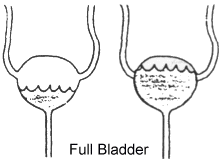
This training is possible for many spinal cord injured persons. Methods used for bladder stimulation:
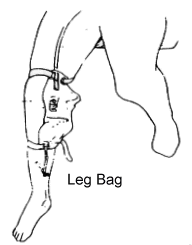
There are many different types of male urinary sheaths available. They provide a convenient unrestricted drainage once connected to leg bag or bed bag. This sheath or external catheter mainly falls in two categories
3.Indwelling Catheter - An indwelling catheter is used sometimes by those men who cannot manage with a condom because of limited hand movements. It is mostly used by those who cannot empty their bladder for medical reasons and thus can avoid kidney damage and other bladder complications. Foley type catheter is normally used
4.Intermittent SeIf-Catheterisation - This technique successfully prevents the bladder becoming abnormally distended and also avoids the problem of high residual urine and it's inherent dangers. It is sufficient to follow a clean procedure then sterile one. This is because any bug that is introduced should not be able to get a hold as the bladder is being efficiently emptied at regular intervals and unlike an indwelling catheter, there is no permanent channel open for infection to occur.
The main surgical options available are
COMPLICATION OF BLADDER MANAGEMENT
1.Urinary Infection
symptoms indicating urinary infection
Steps to Prevent Urinary Infection
Treatment for Infection
Autonomic Dysreflexia
People with Spinal cord injury above the T6 level can suffer from a sudden upsurge in blood pressure and it could be life threatening. It is a medical emergency as it could lead to fits, a cerebral hemorrhage (stroke) and death. It is caused by pain, irritation or over stimulation in a paralyzed part of the body. The body's normal reflex is to constrict blood vessels and speed up the heart beat, but because of the spinal cord injury control mechanism do not operate and blood pressure rises. It is important that you empty your bladder immediately.
Symptoms
Causes
Treatment
Removing the cause - Bladder
Removing the cause - Bowel
2.Stone (Calculi) Formation
Obstruction of urine flow^ and infection . Most of the signs and symptoms of calculus formation are similar to urinary infection. Difficulty in passing urine, bloods in the urine and recurring bladder infections is symptomatic enough to consult a doctor as surgery is necessary to remove stones. Can also be removed by SWL.
Prevention